I’m an accountant who ran my finances in Excel for years — then AI let me build the app I always wanted
For years, the first thing I did each month was duplicate a spreadsheet. Same file, new name — CT, the year, the month — a fresh copy of the previous one, carried forward by hand. That was the ritual. Open last month, save as this month, re-point the opening figures, and carry on.
I’m a certified accountant by training, so this was never a shoebox of receipts pretending to be a system. It was a proper one: double-entry, every movement booked against its counterpart, results separated from the balance sheet. It told me, at any moment, exactly where my money was and where it had been. For a long time, Excel was more than enough to hold it.
The cracks were always in the same places
The problems were never with the accounting. They were with the container.
The first was the rollover. Every month — and worse, every year-end — I was the engine. I copied the file, carried balances forward, closed the results by hand. Nothing was wrong with doing it manually; it just had to be done, perfectly, every single time, by me. Miss a step and the whole chain downstream is quietly wrong.
The second was sheer volume. A spreadsheet that records every line of every month, year after year, eventually runs into walls — row counts, sluggish recalculation, the growing dread of one mis-dragged formula silently corrupting a column. I wasn’t worried the method would fail. I was worried the tool would.
What I wanted wasn’t a different system. The system was good — it was mine, and it was sound. I wanted to preserve it, lift it out of the spreadsheet and into something built to hold it: a real application, with the same logic, that did the repetitive parts for me.
Where it always stalled before
This is the part where, in previous years, the idea died.
Turning my spreadsheet into an actual app meant code. The closest I could realistically reach was VBA and macros, so I pushed them as far as they would go — a full interface built on top of the workbook: data-entry forms, a dashboard, buttons for everything, charts down the side. From the front it almost looked like an application. But it never was one. Underneath it was still a spreadsheet, carrying every one of Excel’s limits, and each feature I bolted on made it a little more fragile. A genuine program — its own windows, its own database, a year-end close that just happens — was on the other side of a skill I didn’t have and wasn’t going to acquire from scratch in my spare time.
So for years the real app stayed unbuilt. What I had instead was the Excel version — battle-tested, complete in its logic, and permanently pressed against the ceiling of the tool it lived in.
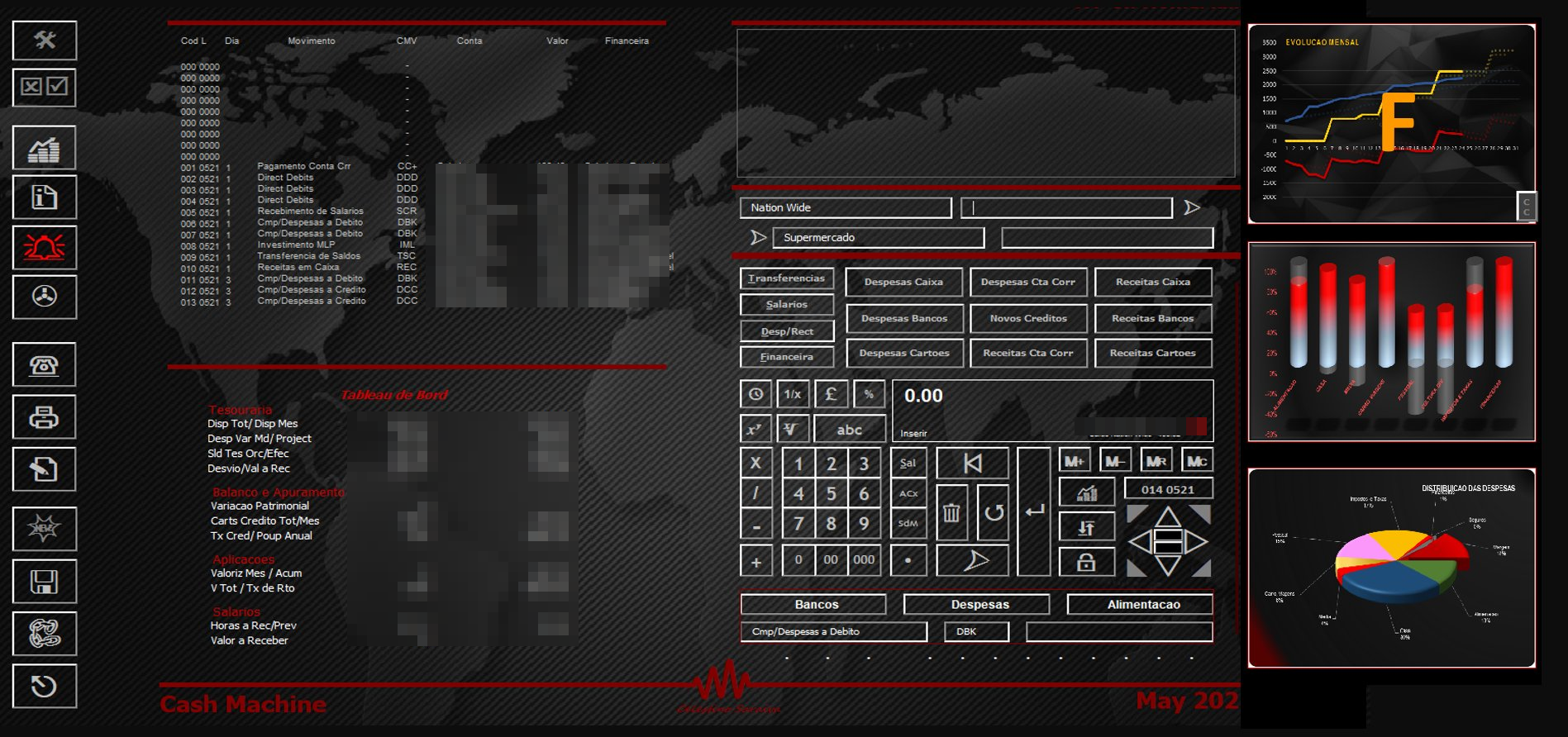 Before: “Cash Machine”, built entirely in Excel with VBA — about as far as a spreadsheet can be pushed. (Account names and figures redacted.)
What changed
What changed was that I could finally hand the execution to something else.
I want to be precise about the division of labour, because it’s the whole point. The financial design was mine — the double-entry model, the chart of accounts, how results close at year-end, what a balance sheet has to reconcile to. None of that came from AI. What AI gave me was the part I’d always been missing: it wrote the code. I described the behaviour I needed, the way I’d describe a requirement to a developer, and it produced something I could run, test, correct, and run again.
It turned a decades-old design into a working program — not by knowing accounting, but by translating accounting I already knew into software I couldn’t have written alone.
What I ended up with
The result is K-Id: the spreadsheet I’d been maintaining for years, finally as a real desktop app.
- True double-entry, the same model I’d always used — no stored balances to drift out of sync; every figure is summed from the underlying movements.
- Automatic year-end close, the ritual that used to be mine to perform by hand, now handled by the program.
- A balance sheet that reconciles the way it’s supposed to.
- Local-first. It lives on my machine. No cloud account, no syncing my finances to someone else’s server.
- No subscription. It doesn’t bill me every month to look at my own money.
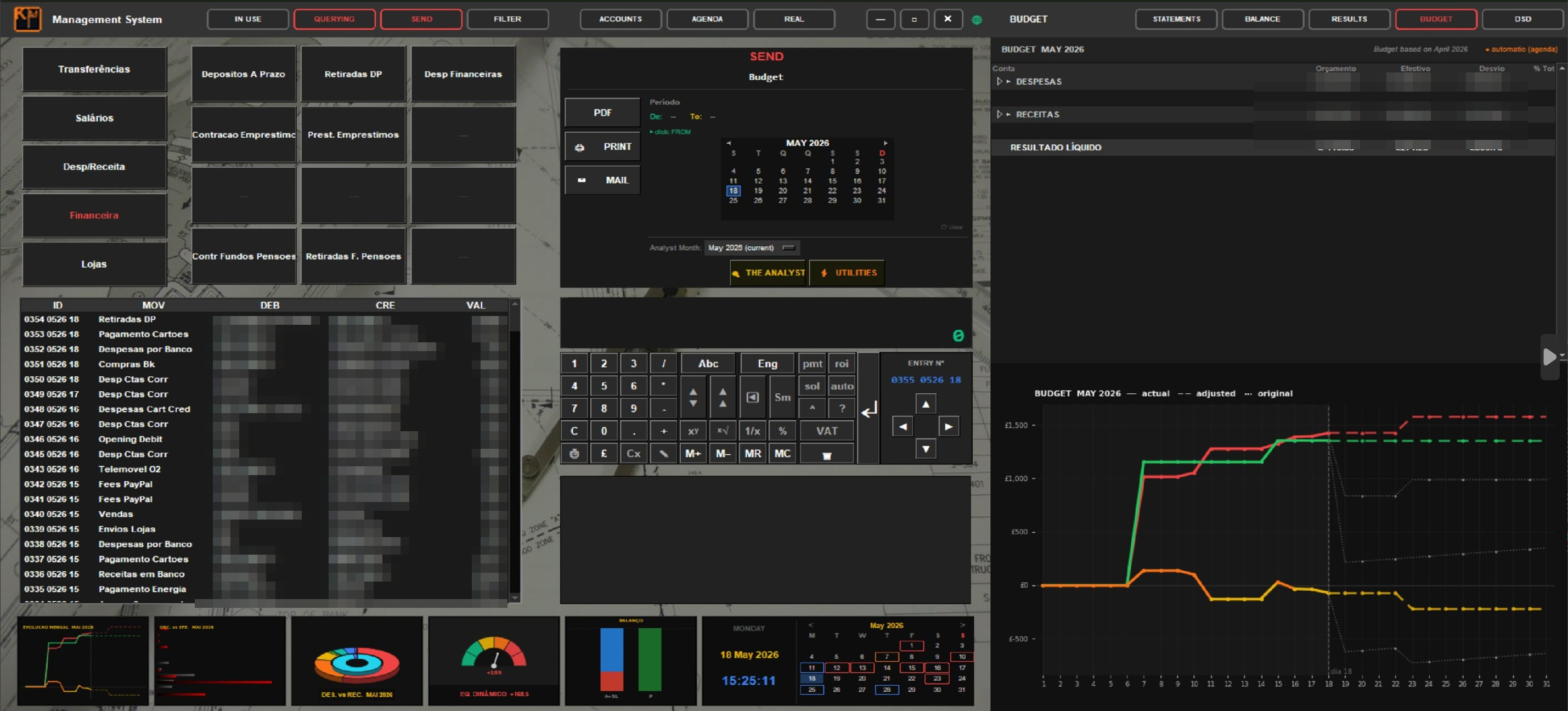 After: K-Id — the same double-entry method, now a real application with budgeting, results and a balance sheet. (Account names and figures redacted.)
That last pair matters more to me than any feature. My finances are mine. I didn’t want the price of organising them to be a recurring fee and a copy of my data sitting on a platform I don’t control.
The part I didn’t expect to write
I built this for myself, to scratch my own itch. But the longer I used it, the more I recognised the itch wasn’t unique to me.
If you’ve ever kept your money in a spreadsheet, you know the feeling: it works, right up until it’s the thing standing between you and an accurate picture. You’re carrying it forward by hand, nudging formulas, half-trusting the total. At some point the honest thought arrives on its own — this needs to be a real system, not a file I babysit.
That thought is what K-Id is for. It’s an accountant’s method, kept intact, in software an accountant couldn’t have written without a little help — and that help is now good enough that the gap between “I know exactly how I want my finances organised” and “here’s the app that does it” has basically closed.
I crossed that gap. If you’ve been circling it, it’s narrower than it looks.